Why does AI adoption stall right after the first successful pilot?
A successful pilot and a production-ready rollout are different tests. Here's why most AI pilots stall right after proving themselves, with 2026 data on the gap.
It isn't news that AI pilots are stalling in 2026, with most never making it to production. What's less examined is the assumption sitting underneath that number: a quiet belief that moving from a working pilot into production should be the easy part, mostly a matter of flipping a switch once the concept is proven. It never has been, and that was true long before AI showed up.
Every major transformation I've managed needed a real plan to get from a working pilot to a running production system, project management, data preparation, workflow redesign, training, and the investment behind all of it, in people and in systems. If that planning didn't happen before the pilot because a team wanted to move fast, it still has to happen before the launch, or the initiative sits exactly where most AI pilots are sitting right now. What gets managed gets done, and that's just as true for an AI rollout as it was for every transformation before it.
The 2026 data backs this up, and it points to something more specific than a missing meeting on the calendar.
What a pilot actually tests, and what it doesn't
A pilot is generally built to answer one central question: does this work at all. Along the way it usually shows how well it works and how hard it was to pull off too, but proving the concept is the headline job. It's typically run by people who already wanted it to succeed, on data that was cleaned up for the occasion, with someone standing by to catch mistakes before anyone downstream saw them.
The problem is that none of that tells you whether the same process holds up on the messier data every other team has, without a champion hovering over it, at ten or a hundred times the volume. A pilot that clears its own bar can still fail every one of those follow-up questions, and usually nobody wrote the second test down in advance.
What the 2026 data actually shows
Deloitte's State of AI in the Enterprise: The Untapped Edge, a 2026 survey of 3,235 business and IT leaders across 24 countries, found:
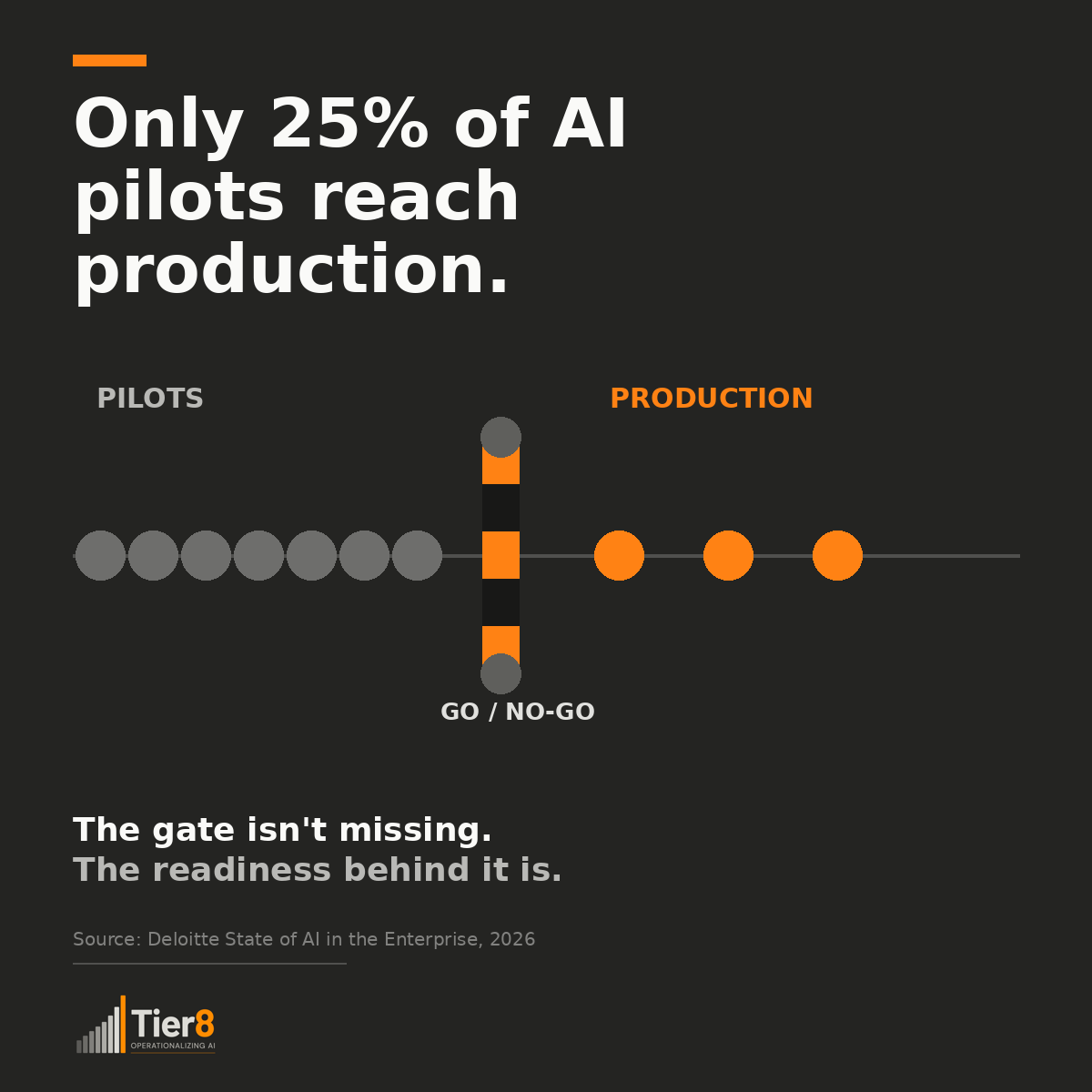
- Only 25% of organizations have moved 40% or more of their AI pilots into production, though 54% expect to reach that threshold in the next 3 to 6 months.
- Only 30% report redesigning key processes around AI at all, and 37% say their AI use still sits at a surface level.
- Only 21% describe their governance model for autonomous AI agents as mature, even though most plan to deploy agents within two years.
Deloitte's own explanation for the gap isn't a missing go/no-go decision meeting. The report points to competing organizational priorities: teams have to keep running what already works while also building what's new, and the new thing keeps losing that argument for attention.
KPMG's 2026 analysis of stalled enterprise AI pilots makes a related point from a different angle: "AI doesn't scale because a model performs well. AI scales because the underlying IT environment can absorb and operationalize it repeatedly." A pilot can succeed and still meet an organization that isn't built to run it at scale yet, not because nobody decided, but because nobody had finished building what the decision actually depended on.
Grant Thornton's 2026 AI Impact Survey of 950 business leaders across ten industries found organizations with fully integrated AI are nearly four times more likely to report AI-driven revenue growth than organizations still in pilot mode, 58% compared to 15%. A pilot that never leaves pilot status doesn't just stay stuck. It keeps the organization stuck with it.
Four things a successful pilot doesn't prove
- That the data holds up at scale. Pilot data is usually curated. Production data is whatever the rest of the organization actually generates, inconsistent formats and all.
- That the process was redesigned, not just accelerated. A pilot can succeed while sitting entirely outside the real workflow. Moving it into production means changing the workflow itself, not just extending the pilot's runtime.
- That someone specific owns it going forward. A pilot often runs under whoever championed it. Production needs a named owner who's accountable for it long after the original champion has moved to the next project.
- That the value is worth the cost at real volume. A pilot's economics are usually theoretical. Production is where the actual cost per unit of value gets tested for real, and not every pilot that works still pencils out once it does.
Does naming it a go/no-go decision fix the stall?
Deloitte State of AI in the Enterprise, 2026; KPMG 2026 analysis; Grant Thornton 2026 AI Impact Survey
No. A go/no-go gate is the right shape for this decision, a defined point where the four things above get checked before anything moves further. But the label alone doesn't create the checking. Calling a meeting a go/no-go gate while the data, process, ownership, and cost questions are still open just moves the same stall into a room with a name on the calendar. The gate has to be loaded with real criteria, and someone has to be willing to return a genuine no or not yet when those criteria aren't met, not wave a pilot through because it already worked once. That last part is usually where competing priorities take over: saying no or not yet to a pilot that already proved itself is a harder conversation than just letting it keep running, so drifting is what happens by default.
Does more budget fix the stall?
Money can pay for infrastructure and more pilots, but it doesn't create the discipline that decides which pilots deserve to scale and what has to be true first. An organization can fund twice as many pilots and still stall at the exact same rate afterward, because the bottleneck was never the number of pilots run. It's whether the four things above get built and checked before a pilot's early success gets asked to carry more weight than it can actually hold.
Three questions worth asking before a pilot's go/no-go decision
- Has anyone tested this against real, messy production data, or only the clean sample the pilot ran on?
- Is there a named owner for this once it's in production, someone other than whoever championed the pilot?
- Does the projected value still hold up at real volume, or was the pilot's economics never actually stress-tested?
An unclear answer to any of these means the pilot isn't actually ready for a go decision, whatever the pilot results themselves looked like.
Where this fits into the bigger picture
Integration into Work is one of the five pillars the RAISE OS™ AI Maturity Assessment measures separately from a simple pilot count, precisely because a successful pilot and an organization's readiness to run that same capability at scale are different questions with different answers. Using AI and having it structurally integrated into work were never the same milestone, and a real go/no-go decision, one actually loaded with the criteria above, is where that difference gets tested. What gets managed gets done. The move to production won't happen on its own, whatever the pilot itself proved.
Find out where your organization actually stands
Turn this into a sequenced transformation plan.
Founding Partner Program: five organizations, no cost
Apply for the Founding Partner Program →