Why do most AI pilots never make it to production?
Only 25% of companies move most of their AI pilots into production. Here's what actually separates a pilot that scales from one that quietly stalls forever, with 2026 data on why.
Only 25% of companies have moved 40% or more of their AI pilots into production, according to Deloitte's 2026 State of AI in the Enterprise report. Most pilots don't fail outright, they just stall somewhere between the demo and the rollout, and nobody ever makes the call to scale them or shut them down. The direct answer to why: most pilots launch missing three things that determine what happens next.
- Data clean enough to run at scale
- A measure of success agreed on before launch
- A real plan for getting the people who'll use it to change how they work
What it actually costs when a pilot stalls
This isn't limited to a handful of unlucky companies. Gartner has forecast that more than 40% of agentic AI projects will be canceled by the end of 2027, citing runaway costs and unclear business value. This isn't a story about AI not working. It's a story about what happens between a working demo and an organization actually being able to move it out of the pilot phase.
The data problem nobody notices until it's time to scale
Pilot data and production data are rarely the same thing, even when they come from the same company. A small, curated dataset used to prove a concept often has none of the inconsistent formatting, missing fields, or unclear ownership that shows up once a tool touches real, messy, company-wide data. Data readiness gaps derail a significant share of AI projects specifically at the point they try to expand past a pilot, which is exactly why a pilot that looked clean can stall the moment it meets production data.
Why "it went well" isn't a success metric
Roughly 74% of leaders want AI to grow revenue, but only 20% say they've actually seen it happen, according to Deloitte's 2026 research. That gap usually traces back to before the pilot even started: nobody wrote down what success would specifically look like, so there's no way to know later whether it happened. A pilot without an agreed number, hours saved, error rate, cycle time, revenue touched, can generate genuine enthusiasm and still have no defensible case for the investment it would take to scale it.
AI pilots are still projects
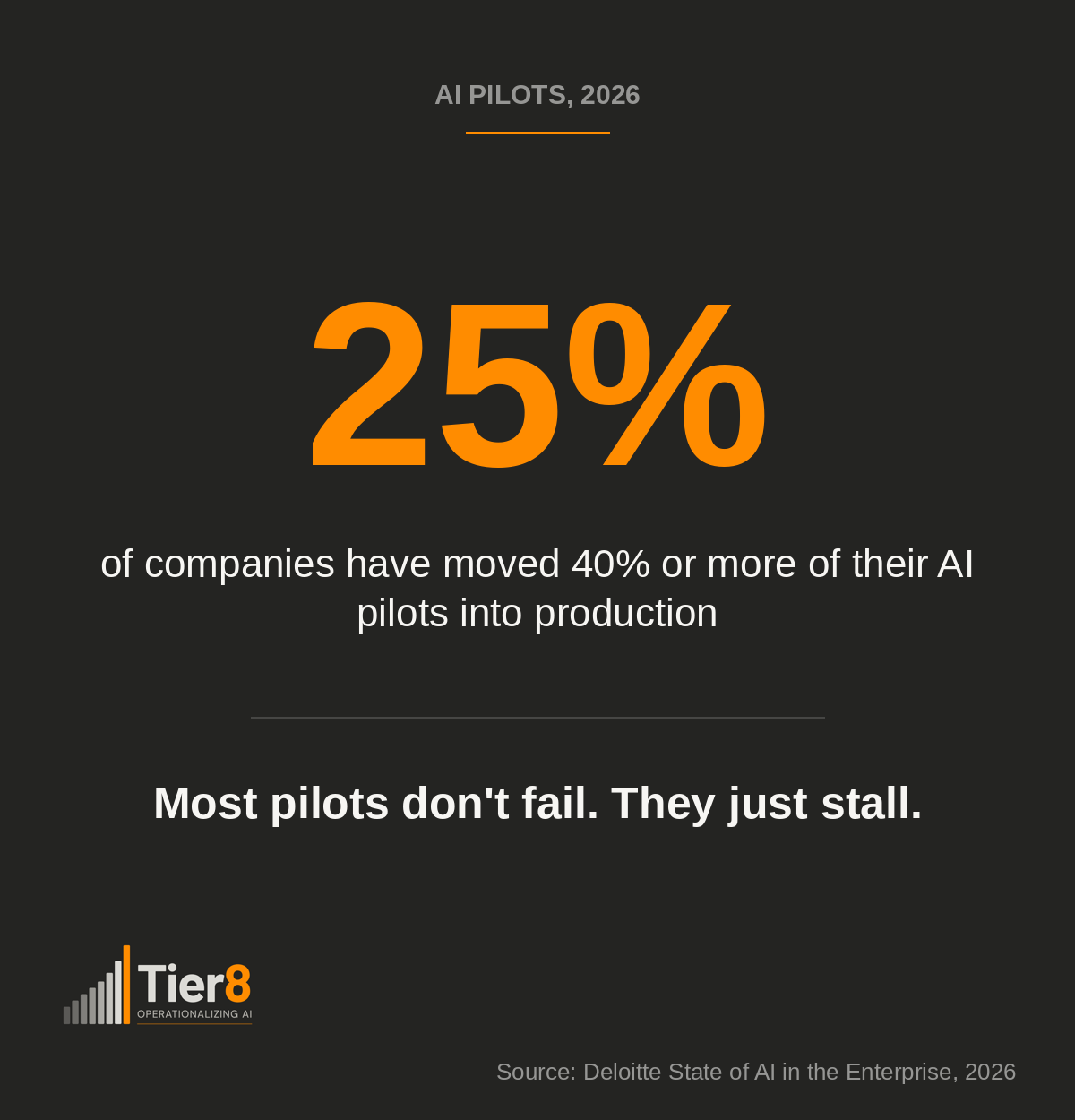
Deloitte State of AI in the Enterprise, 2026
When I ran programs and projects, before AI, we never scheduled a pilot or proof of concept without a full plan behind it: a scope, a sponsor, a success measure, and a stage-gate with a pre-determined next step, whichever way the pilot landed. That's standard project management, not a special step. What I am seeing with AI pilots is that same discipline getting skipped, as if being about AI means the normal planning rules don't apply.
I implemented an RPA project once where we had six months to prove automation would work on one customer support workflow. That six-month window, and the checkpoint at the end of it, were built into the plan from day one, along with what would happen next depending on the outcome: full rollout if we hit the mark, a defined fallback if we didn't. AI pilots are running the same kind of proof of concept that RPA and plenty of other technologies have run for years. The technology changed. What's missing is the end-to-end plan that used to come standard with a pilot like this.
I've also learned to distrust "the pilot went well" as a status update on its own. It tells you whether people liked using something, not whether the organization is set up to decide what happens next. AI pilots are following that same pattern: the demo works, everyone's encouraged, and there's no plan in place that forces an explicit go or no-go decision.
The part that actually derails momentum: the people, not the tool
S&P Global found that 42% of companies abandoned most of their AI initiatives in 2025, up from 17% the year before, and that the average organization abandoned 46% of its AI proof-of-concepts before they ever reached production. A tool that works in a controlled pilot still has to survive contact with people's actual daily workflow, and that requires the same change management any other initiative needs: training, a clear owner, and a real plan for how the rollout affects the jobs of people who weren't in the room for the pilot. Again, this is no different than any other non-AI digital rollout.
Four checkpoints most pilots skip
These aren't AI-specific ideas. They're what any well-run pilot or proof of concept already includes in its project plan.
- A data readiness check before launch. Someone actually looks at whether production data resembles the pilot's clean dataset, not just whether the demo worked.
- A named success metric, written down before day one. Hours saved, error rate, revenue touched, whatever it is, defined before anyone gets attached to the outcome.
- A change management plan for people who weren't in the pilot. Training, a clear owner, and a real accounting of how the rollout changes someone's actual job.
- An explicit go or no-go decision on the calendar. Not an open-ended "let's see how it goes," but a specific date someone has to make the call, with a pre-determined next step either way.
Why this matters for the next pilot on your roadmap
A pilot that never gets a go or no-go decision isn't neutral. It quietly uses up budget, credibility, and goodwill that a real production rollout will need later. Adoption & Change is one of the five pillars the RAISE OS™ AI Maturity Assessment measures, precisely because a successful demo and an organization's actual readiness to scale something are two different questions, and conflating them is how a promising pilot turns into permanent limbo instead of either a scale-up or a clean, well-planned end.
Find out where your organization actually stands
Turn this into a sequenced transformation plan.
Founding Partner Program: five organizations, no cost
Apply for the Founding Partner Program →