Do we need an AI governance framework if we're not in a regulated industry?
Regulation isn't the main reason companies need an AI governance framework in 2026. Here's what's actually driving it for unregulated industries, and what a lightweight version looks like.
Regulation is usually the first reason people give for needing an AI governance framework, and it’s also the weakest one. The real reasons, data exposure, inconsistent decisions, and vendor or customer trust, exist whether or not a regulator is watching. Yes, an unregulated company still needs a framework. Not because a law will eventually require one, but because the risks a framework manages don’t wait for regulation to catch up.
What the 2026 data shows about mid-market companies specifically
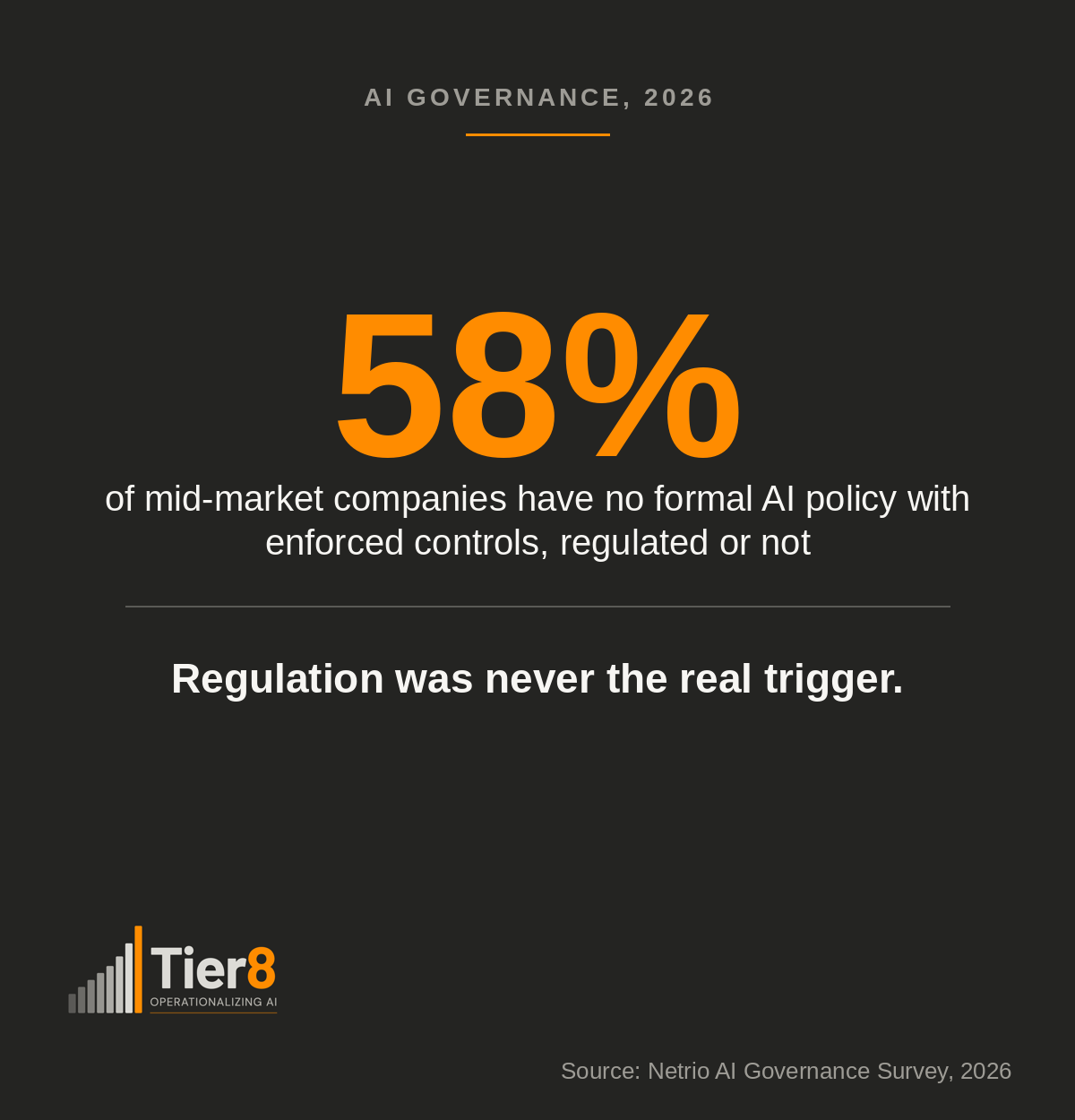
A 2026 Netrio survey of 401 U.S. IT leaders at companies with 200 to 5,000 employees, most with no AI-specific regulatory mandate, found 58% lack a formal AI policy with actively enforced controls. In the same survey, 73% had experienced either a confirmed AI-related security incident (42%) or a near-miss (31%), and 47% said they lacked complete visibility into which AI tools were even in use across the company. The absence of a regulator hadn’t made the risk absent. It had just made it less visible until something went wrong.
What a framework actually protects against, regulation aside
None of these five risks check whether a regulator has jurisdiction before they show up.
- Data exposure. An employee pasting client or financial information into a public AI tool doesn’t check whether the company operates in a regulated industry first.
- Inconsistent decisions. Two teams using AI differently on similar decisions, one with a review step and one without, creates inconsistency a regulator was never going to be the one to catch.
- Vendor and customer trust. More enterprise buyers now ask vendors AI-specific questions before signing, whether or not either company is in a regulated industry.
- Tool sprawl. Without a shared framework, every team adopts AI on its own terms, and nobody can say with confidence what’s actually in use.
- The ability to explain a decision later. If an AI-assisted decision gets challenged, “we didn’t think we needed a policy” is not an answer anyone wants to give, regulator or not.
Where I’ve watched this play out, minus the AI
The programs and projects I’ve run over twenty years had no external regulator requiring a specific process. Nobody was going to audit whether we had a documented change-approval step or a named point of escalation. That never made those things optional in practice though. The programs that skipped structure because “nothing requires it” were the ones where a decision nobody remembered agreeing to caused a problem months later, with no record of who’d approved what or why. The absence of a mandate never removed the risk. It just removed the paper trail that would have made the risk visible sooner.
AI governance is running into the same gap now, just with higher-stakes data and faster-moving tools behind it. The companies waiting for a regulation to force the issue are optimizing for the wrong trigger.
Is this only worth doing once you’re big enough to need it?
Netrio AI Governance Survey, 2026
The data says no. Schellman’s 2026 survey of 525 U.S. professionals at companies with 500 or more employees found that among organizations with AI governance in place, 57% cited improved internal efficiency as a top benefit, ahead of the 49% who cited readiness for emerging regulations.
A separate 2026 survey by Brafton found some of the highest AI policy adoption rates in sectors with no AI-specific regulatory pressure at all: marketing and creative services and technology companies both landed above 91%. Regulated status isn’t what’s actually driving adoption in the data. Operational benefit is.
A quick check for whether you actually need this now
Ask three questions instead of waiting for a regulator to ask them first.
- If an AI-assisted decision got challenged tomorrow, could anyone explain how it was made and who approved the process behind it?
- Does every team know which AI tools are approved, or does that answer depend on who you ask?
- If a new enterprise customer sent over a vendor security questionnaire with AI-specific questions on it, would there be a real answer ready, or would someone be improvising one on the spot?
A shaky answer to any of these means the framework is already overdue, regardless of an industry requires it.
Where this fits into the bigger picture
Responsibility & Governance is one of the five pillars the RAISE OS™ AI Maturity Assessment measures, and regulation was never the actual trigger for building it well. The companies that treat governance as something to build once a law demands it are managing the wrong risk on the wrong timeline, since the exposure a framework manages was already there the day the first AI tool got adopted.
Find out where your organization actually stands
See where your leadership team actually stands.
$299, 15 min/person, board-ready report
Take the assessment or explore the Transformation Roadmap →