Who should own AI governance in a mid-market company that can’t afford a dedicated function?
Most mid-market companies don’t need a dedicated AI governance hire. Ownership usually belongs with an existing accountable executive, supported by a lightweight process, not a new department.
Most mid-market companies don’t need a dedicated AI governance hire. Ownership usually belongs with an existing accountable executive, often the COO, CTO, or CFO depending on where AI risk concentrates in the business, supported by a small cross-functional review group rather than a new role. In 2026, the companies handling this well aren’t the ones with the biggest team. They’re the ones with one clearly named owner and a lightweight process behind them.
Why this question keeps coming up in 2026
AI tools spread through mid-market organizations faster than governance structures do. One team adopts a tool to solve an immediate problem, another team adopts something different for the same problem, and within a few months nobody can say with confidence what’s actually in use or who approved it.
This is less a staffing problem than a clarity problem. Enterprise companies often solve it by building a dedicated AI governance function with its own headcount. Mid-market companies are usually working with enterprise-grade exposure and non-enterprise resources, so that path doesn’t scale down cleanly. Clear ownership, not a new department, is what closes the gap.
What "owning AI governance" actually means
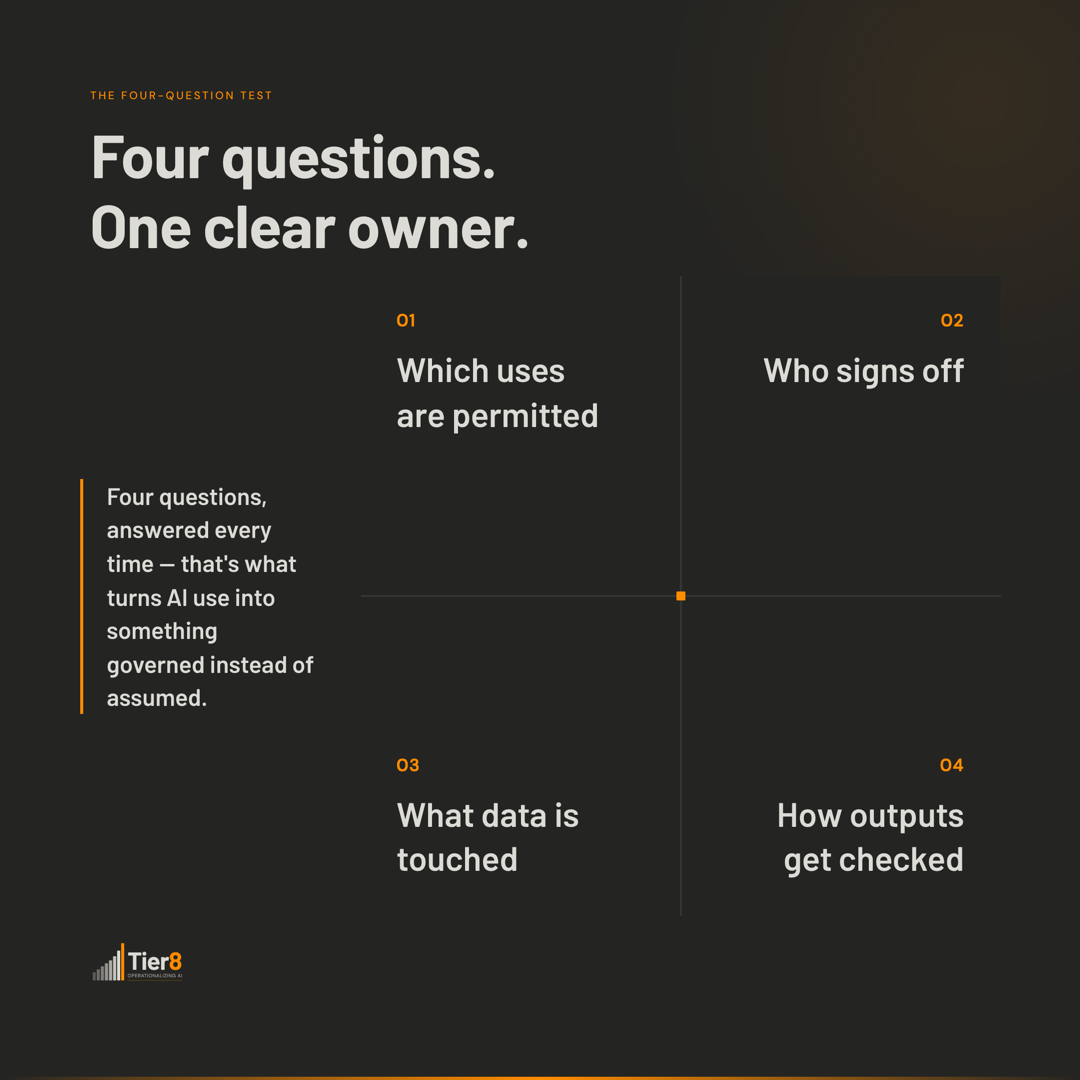
Governance ownership isn’t a technical role. It means being accountable for four decisions: which AI uses are permitted, who signs off on a new one, what data those uses are allowed to touch, and how outputs get checked before they inform something consequential.
None of that requires deep technical expertise. It requires organizational authority and enough visibility across functions to make the answer stick once it’s decided, which is why the right owner is often a business leader, not whoever happens to know the most about AI.
This isn’t as new a problem as it feels
When I built PMOs earlier in my career, before "AI governance" was a phrase anyone used, the same core problem showed up under a different name. A company would take on more initiatives than it could actually support, and there was no agreement on how a project got approved in the first place.
The fix wasn’t a new department. It was a small set of checks built into how projects already moved through the organization: did this align with a stated strategic goal, was there a clearly named owner, were milestones defined so someone could actually track progress against a plan. None of it was labeled governance. It was just how a functioning PMO operated.
AI governance in a mid-market company is largely the same exercise wearing a new name. The four questions above, which uses are permitted, who signs off, what data is touched, how outputs get checked, aren’t unprecedented. They’re the AI-era version of alignment to strategy, named ownership, and milestone tracking. If your organization has ever gotten reasonably disciplined about project governance, you already have the underlying muscle. It just needs to be pointed at a new category of decision.
Does this need to be a full-time role?
For most mid-market companies, no. The obligations around AI governance are real, but they don’t require a full-time function to manage responsibly at this stage. What they require is that someone already in a leadership role treats it as part of their job, with defined time set aside for it, rather than it being everyone’s shared responsibility and therefore no one’s actual job.
Who typically ends up with this responsibility
In practice, ownership tends to land wherever risk is already concentrated:
- COO - when the priority is operational consistency and cross-team process
- CTO or Head of IT - when the priority is tooling, data access, and security
- CFO - when AI is heavily used in financial reporting, forecasting, or vendor decisions
- CHRO - when AI use touches hiring, performance review, or other employee-facing decisions
This ownership is an org-wide assignment, not something that resets by department or workflow. Once a leader is designated, that accountability should carry through every AI or agentic workflow across the company, not just the one that prompted the original decision.
There isn’t one universally correct answer. The right owner is whoever already has the standing to make a decision stick, not necessarily whoever understands the technology best.
A lightweight structure that doesn’t require new headcount
A governance setup that works without adding a role typically includes:
- One named accountable owner, an individual, not a committee
- A short written policy on approved tools and permitted use cases
- A simple intake process for new AI tool requests, even a basic form is enough, as long as requests and decisions get logged somewhere visible and can be checked later
- A quarterly review of what’s actually in use versus what’s officially approved
- A defined escalation path for anything that falls outside policy
This is deliberately minimal. The goal is a system the team will actually follow, not a comprehensive framework nobody has time to maintain.
Questions to repeat for every new AI or agentic workflow
The five-item structure above covers company-wide governance. Each individual AI or agentic workflow also deserves the same three checks:
- What guardrails prevent this workflow from violating policy?
- Is there an audit trail that lets us reconstruct how a decision was made, if we need to?
- Who has oversight, and where does human intervention happen if something looks off?
Asking the same three questions every time is what keeps this scalable without adding headcount for each new AI use case.
What happens without clear ownership
The cost of skipping this shows up as shadow AI. One industry survey found 55% of employees admit to using AI tools their organization hasn’t approved. Gartner projects that more than 40% of enterprises will experience an AI-related security incident by 2030, driven largely by this kind of unsanctioned use.
Without a named owner, closing that gap is difficult, because closing it requires someone with both the authority to set policy and the visibility to notice when it’s being ignored.
How to know if your current setup is actually working
A few honest questions surface the answer quickly. Can you name, right now, who owns this decision at your company? Would that person actually know if a new AI tool got adopted last month? Is there a documented answer to what’s approved, or is it tribal knowledge held by a few people?
If any of those questions stall, ownership isn’t as clear as it needs to be yet, even if someone is technically assigned to it on paper.
Where this fits into the bigger picture
Governance ownership is one piece of a broader maturity picture, and it’s often where leadership teams disagree the most. A CTO and a CFO can hold genuinely different views of who should own this and how much risk is acceptable. The RAISE OS™ AI Maturity Assessment measures Responsibility & Governance as one of five pillars precisely because that kind of disagreement, when it shows up, tends to be more useful than any single score.
See where your leadership team actually stands.
$299, 15 min/person, board-ready report
Take the assessment or explore the Transformation Roadmap →