What's the difference between an AI governance policy and an AI acceptable use policy?
An AI governance policy and an acceptable use policy solve different problems. Here's the structural difference between them, and why most companies in 2026 only have one of the two.
An AI governance policy defines who owns AI risk, how new AI use gets reviewed and approved, and how the organization stays accountable as tools and regulations change. An acceptable use policy (AUP) is narrower: it's the employee-facing document that says which tools are approved, what data can and can't go into them, and what happens if someone doesn't follow it. Confusing the two is common, and it usually shows up the same way: a company writes an acceptable use policy, calls it their AI governance, and still has no clear answer for who's accountable when something goes wrong.
Why mixing these up is such a common, costly mistake in 2026
The two documents solve different problems, but they get written as if they're the same thing. Only 44% of companies have a formal AI policy at all, according to a 2026 survey of 3,500 business and IT leaders, even though roughly 8 in 10 organizations have already deployed or plan to deploy AI agents. Of the companies that do have something in place, most treat it as a single acceptable-use document and never separately establish who owns risk, review, and accountability at the governance level.
What an AI governance policy actually covers
Governance is structural, not typically employee-facing. It names who's accountable when an AI system produces a bad outcome, defines the review and approval process before a new AI use case goes live, and sets how the organization tracks and updates its approach as tools and regulations change. It answers a different question than an AUP does: not "what am I allowed to do," but "who is responsible for making sure this stays safe as it scales."
What an acceptable use policy actually covers
An AUP is the employee-facing rulebook: which tools are approved, what categories of data can never go into a public AI tool, and what the consequences are for violating the policy. It's meant to be short enough that someone actually reads it and specific enough to answer real situations, not just state principles. A good AUP tells someone exactly what to do with a client contract or a set of financial figures. A governance policy doesn't operate at that level of detail, and isn't meant to.
Five signs your company has an AUP but not real governance
- AI risk ownership is fuzzy, not assigned. There's a policy document, but no specific person or committee is accountable when something goes wrong.
- New AI tools get approved informally. A team starts using something because a manager said yes, with no formal review step behind it.
- The policy hasn't been updated since it was written. Tools and regulations have changed since the document was created; the document hasn't.
- There's no tiered review for higher-risk use cases. A customer-facing AI feature and an internal drafting tool get treated identically.
- Compliance gets confused with governance. An employee acknowledgment gets treated as evidence the company is actively managing its AI risk.
Any one of these is common at a company still early in formalizing its approach. Most of them at once means there's a rulebook, but no one clearly steering it.
Does a company need both documents, or is one enough?
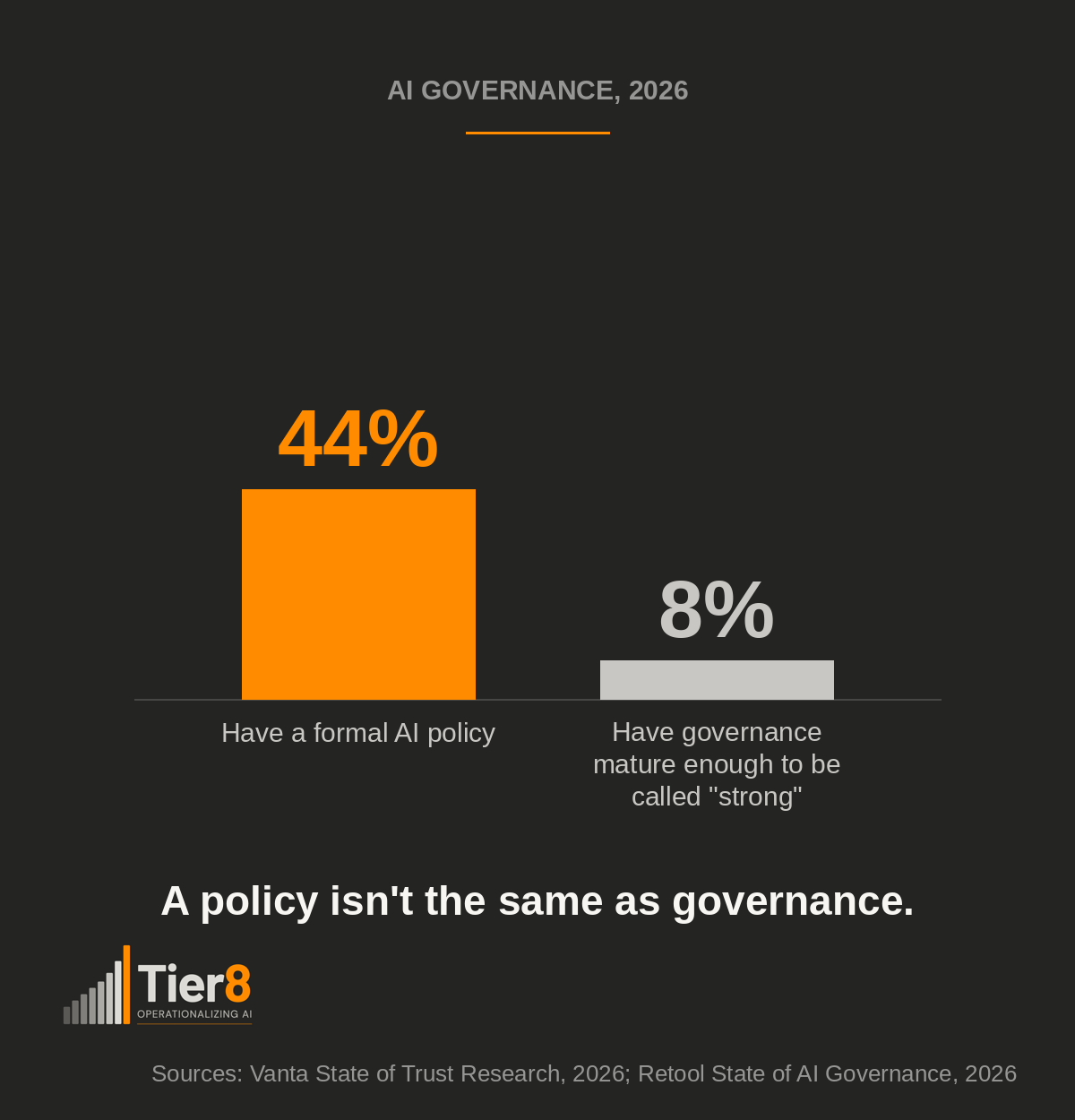
Vanta State of Trust Research, 2026 (44% formal AI policy); Retool State of AI Governance in 2026 (8% strong governance with centralized controls)
Both, and they work at different levels. An AUP without governance behind it is a set of rules nobody's clearly accountable for enforcing or updating. Governance without an AUP gives leadership a framework but leaves employees guessing what it actually means for their daily work. I don't think a single document was ever built to do both jobs well, no matter how carefully it's written, since the audiences and the questions they're answering aren't the same.
That gap shows up clearly in a 2026 survey of 307 senior technology and security leaders:
- Only 8% described their organization's AI governance as strong, with centralized controls, and 11% said they have no formal governance approach at all.
- At the same time, 65% of leaders in a separate global survey say AI adoption is already outpacing their organization's understanding of it, and 70% report unmanaged AI tools already inside their environment that were never reviewed by security.
This structure is not new
I've built governance structures long before AI made the term fashionable. PMOs needed the same two things this problem needs now: a steering committee that actually owned decisions and escalations, and a set of practical guidelines the people doing the work could follow without calling someone every time a question came up. Those were not the same document.
The steering committee met regularly, had real authority to approve or kill initiatives, and was accountable when something went sideways. The practical guidelines lived somewhere else entirely, usually a one or two page reference the team could actually use in the moment.
I've seen those two topics get commingled in a single policy document. The result was predictable: either the document got too long for anyone to reference day to day, or it stayed simple enough to be useful and quietly left out who was accountable for the decisions it implied.
AI governance is running into the same structural problem, just with higher stakes attached to getting it wrong.
How to tell if your organization has one, the other, or both
A few direct questions surface the gap quickly. If an employee has a question about whether a specific AI use is allowed, is there a document that actually answers it? If an AI-related risk needs a decision, is there a specific person or committee that owns making it? Has either document been reviewed since it was written, or is it the same version from whenever AI first came up as a topic?
If the answer to any of these is unclear, that's not a wording problem. It's a sign one of the two documents doesn't exist yet.
Where this fits into the bigger picture
Governance is the foundation the RAISE OS™ AI Maturity Assessment measures under Responsibility & Governance, one of five pillars, because accountability has to exist before adoption, integration, security, and skill-building can be managed with any real confidence. A well-written AUP is necessary, but it's the visible layer of a system, not the whole system.
Find out where your organization actually stands
See where your leadership team actually stands.
$299, 15 min/person, board-ready report
Take the assessment or explore the Transformation Roadmap →