How do we manage AI risk without a dedicated compliance or security team?
You don't need a dedicated AI compliance or security team to manage AI risk well in 2026. Here's the lightweight cycle that closes most of the gap instead.
Most mid-market companies don't need a dedicated AI compliance or security team to put real AI risk governance in place in 2026. What works instead is a named owner already accountable for the decision, running a short, repeatable review cycle on borrowed time from functions that already exist: IT, legal, whoever handles vendor contracts. That's a governance and accountability question, not a security architecture one, and it's a different discipline than designing or hardening the technical controls themselves. The risk doesn't shrink to match the team size. The way you manage it has to.
Adapting the rigor to the team you actually have
Steering committees or governance structures I've been part of ran on a subset of the staff a textbook version of that function would call for. The rigor didn't come from headcount. It came from being deliberate about what got reviewed every cycle versus what got flagged and set aside, and from treating the review itself as a fixed, protected block of time rather than something that happened whenever someone found a spare hour.
That's the same trade a company managing AI risk without a security function is actually making. The choice isn't between a full program and no program. It's between a lightweight cycle that runs consistently and a comprehensive one that exists on paper and rarely happens, because there was never enough dedicated capacity to run it the way it was designed.
Naming an owner isn't the same as managing the risk
Naming an accountable owner is the first decision in setting up AI risk management, not the last one. Once someone owns AI risk, the question that actually determines whether anything gets managed is what that person does with the time they have. A named owner with no repeatable process still ends up reacting to problems one at a time as they surface, which looks a lot like having no owner at all from the outside.
What 2026 data shows about the gap between naming an owner and actually managing the risk
Netrio's 2026 survey of 401 U.S. IT leaders at companies with 200 to 5,000 employees found only 26% describe their AI use as scaled and governed enterprise-wide, even though the same companies are investing heavily, 88% plan to spend at least $100,000 on AI this year.
Just 42% have formal AI policies with controls that are actually enforced, and only 53% report full visibility into which AI tools are in use at all. In the twelve months before the survey, 42% of these companies had a confirmed AI-related security incident or exposure, and another 31% reported a near miss.
Retool's separate 2026 survey of 307 senior technology and security leaders found the accountability gap sitting underneath those numbers: 44% either have no clear default for who's responsible when an AI tool causes a problem, or haven't decided yet. Only 8% describe their organization's AI governance as strong.
What this means in practice: if your organization has named someone responsible for AI risk but hasn't given them a specific, recurring block of time to actually review it, you're in the majority, and that majority is where the 42% who had an incident or near miss came from. Naming the owner turns out to be the easy part. The review cycle is what's usually missing.
Five things that can substitute for a dedicated AI risk team
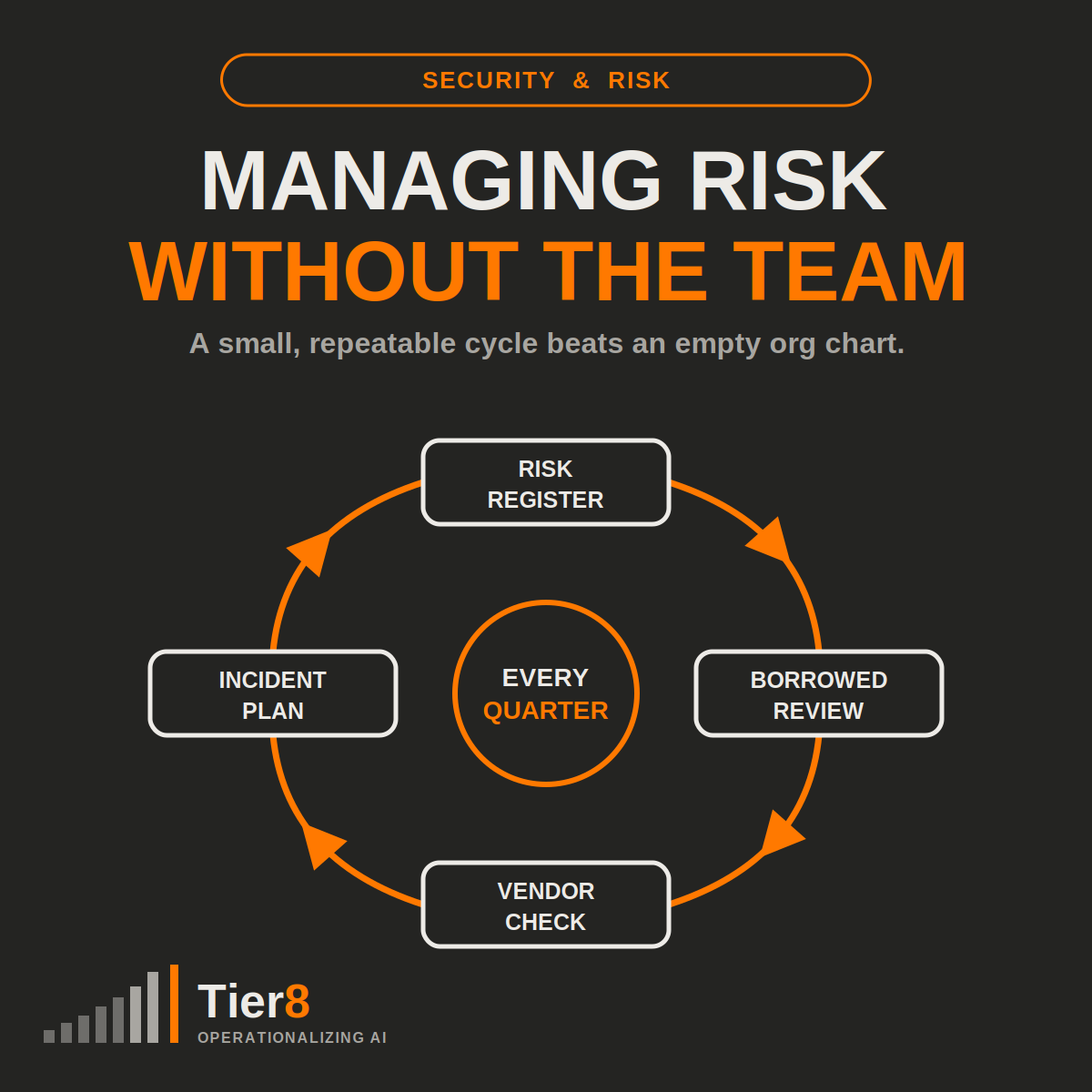
Original Tier8 diagram, built in SVG (vector) at 1200x1200 to match the Insights image style standard.
- A short risk register, not a comprehensive framework. A running list of the specific ways AI is actually being used, rated by likelihood and consequence, reviewed on a set schedule, does more real work than a framework document nobody has time to operationalize.
- Borrowed capacity, put on a calendar. A few protected hours a month from IT, legal, or whoever already reviews vendor risk beats an unstaffed AI security role that exists in an org chart and nowhere else.
- Vendor risk questions folded into procurement that already happens. Anyone buying a new AI tool already goes through some kind of purchasing or contract review. Adding a handful of AI-specific questions to that existing step covers new tools without inventing a parallel process.
- A one-page incident response plan, tested once. It doesn't need to anticipate every scenario. It needs to say who gets called first, what gets shut off, and who talks to customers, and it needs to have been read by the people on it at least once before it's needed for real.
- A quarterly cadence instead of continuous monitoring. Continuous monitoring is the enterprise version of this problem. A quarterly check against the risk register, with anything urgent escalated the moment it's found, matches the actual pace at which most mid-market AI use changes.
Does borrowing a few hours from IT count as a real program?
It's more than most companies currently have, which is closer to nothing. It isn't the same as a fully staffed security function, and it won't catch everything a dedicated team would; deep technical audits and round-the-clock monitoring aren't things a few borrowed hours a month can replace. But measured against the alternative most mid-market companies are actually running today, an unreviewed patchwork of tools and an incident plan that exists only in someone's head, a lightweight cycle that runs on schedule closes most of the real gap.
The goal isn't matching an enterprise security budget. It's not being the company with 42% of Netrio's respondents in the "had an incident and didn't have a plan" column.
A few questions that separate a working cycle from a stalled one
- Is there a specific date on the calendar for the next risk review, or does it happen only when something goes wrong?
- If a new AI tool got adopted last month, would the procurement or contract process have actually caught it?
- Has the incident response plan been read by the people named in it, or does it only exist as a document nobody's opened since it was written?
If the honest answer to any of these is no, the risk isn't being managed yet, whatever the org chart says about who's supposed to be doing it.
How this connects to the rest of Security & Risk
Security & Risk is one of the five pillars the RAISE OS™ AI Maturity Assessment measures on its own, and a mid-market company can score reasonably here without ever building a dedicated function, as long as the lightweight cycle above is actually running. What sinks the score isn't the absence of a security team. It's the absence of anything repeatable standing in for one.
Find out where your organization actually stands
See where your leadership team actually stands.
$299, 15 min/person, board-ready report
Take the assessment or explore the Transformation Roadmap →