What does "AI readiness" mean beyond having the technology?
Most companies already have AI in production, so "are we ready for AI" is the wrong question. Here's why readiness is really a use-case-by-use-case question, with 2026 data on where it breaks down.
"AI readiness" gets asked like a single yes-or-no question: is the organization ready for AI. That question is already out of date for most companies. Cloudera’s 2026 Data Readiness Index found 96% of organizations have integrated AI into core business processes, so "ready for AI" isn’t really what’s still open. What’s open is whether an organization is ready for the next specific use case it wants to roll out, and that answer changes use case by use case. A company can be genuinely capable of running one AI workflow well and nowhere close to ready for the next one, which is why we measure AI maturity, an ongoing, graduated capability, rather than treating readiness as a single checkbox a company either has or doesn’t.
Why "ready for AI" is already the wrong question
Cloudera’s 2026 Data Readiness Index, based on 1,270 IT leaders at companies with more than 1,000 employees, found that 96% of organizations have already integrated AI into core business processes. At the same time, 80% say those same initiatives are constrained by limited data access, and only 18% describe their data as fully governed. Companies that already cleared the “do we have AI” bar are still stalling case by case, which means the blocker was never overall adoption. It’s whether each specific use case has what it needs underneath it.
Three things that decide readiness for one use case, not the whole company
- Data. Not whether the company has data broadly, whether the data feeding this specific use case is accessible, consistent, and governed enough that the output can be trusted. Cloudera’s research found 85% of companies believe they have a clear data strategy, which makes the 80% reporting access constraints even more telling: a strategy on paper doesn’t tell you whether the data behind any one workflow is actually ready.
- Process. Whether the workflow this use case touches got redesigned around the tool, or whether AI just got bolted onto the process that existed before it showed up. That answer is different for every workflow in the building, not a single company-wide state.
- People and leadership. Whether the specific people running this use case have the skill and standing to raise concerns, and whether leadership is actually prepared to lead through this particular change rather than a generic one they approved the budget for.
The leadership gap the data keeps confirming
A 2026 ManpowerGroup Talent Solutions study of 80 C-suite, CHRO, and senior talent leaders found only 3% rated their organization’s leaders as “highly prepared” to lead AI adoption, and just 17% described their organization’s workforce readiness as advanced enough that AI capability is genuinely embedded into how work gets done. That gap isn’t evenly distributed either. A leadership team can be genuinely well-prepared to lead an internal drafting tool rollout and completely unprepared for a customer-facing AI agent, because the two use cases ask for different judgment, not just more of the same confidence.
Where I’ve watched this gap show up before AI
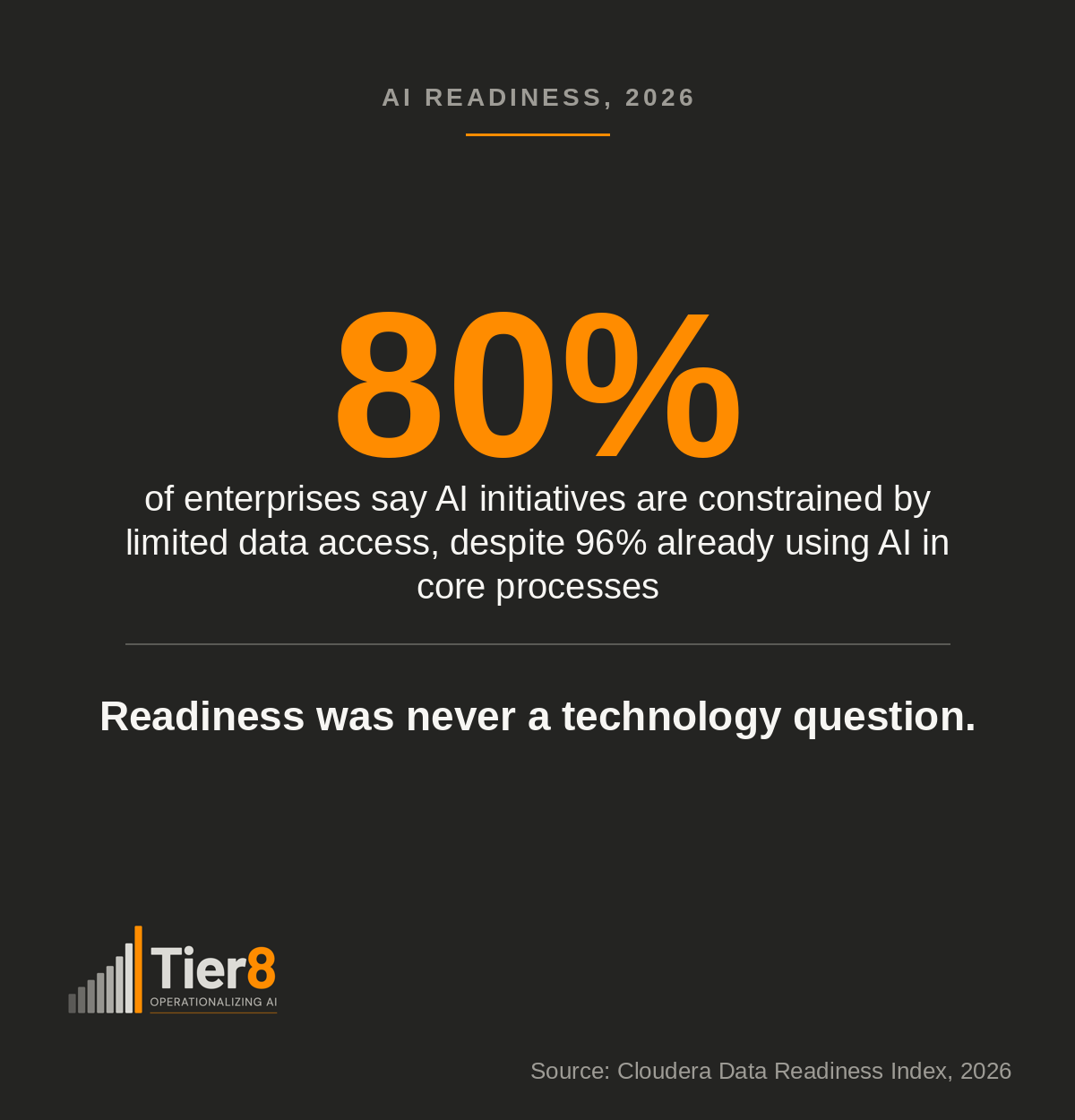
Cloudera Data Readiness Index, 2026
Long before AI, I coordinated the reporting and status data that fed governance and steering committees, the numbers leadership used to decide what was actually on track. The technology for tracking that data was rarely the problem. What consistently undermined the decision was inconsistent data feeding into it. On one product development program, we pulled percent-complete numbers straight out of Jira, but the same field meant something different on different teams. Some teams scoped their epics to run from design through launch; others left design out and tracked it as a separate line. Rolled up together, the numbers looked like a clean apples-to-apples view of progress. They weren’t, and leadership made real decisions on that rollup anyway, because a dashboard that looks complete doesn’t announce what’s missing from it.
That unevenness wasn’t uniform across a company either. One team’s numbers meant exactly what they said; another team’s, running in the same program, didn’t. AI is producing the same pattern now, some use cases sit on data and process solid enough to support them, others don’t, which is exactly why a single “are we AI ready” verdict was never going to be accurate for an entire organization at once.
Does having a written AI strategy mean you’re ready?
It depends which strategy you mean, and that’s usually where this gets muddled. An AI business strategy says which use cases the company wants to pursue and why they fit where the business is headed. A data strategy says whether the information those use cases actually depend on is accessible, consistent, and governed. Readiness rides on the second one. A company can correctly pick a use case that fits its business strategy perfectly and still not be ready for it, because Cloudera’s data shows 85% of companies believe they have a clear data strategy, yet 80% report their AI initiatives are constrained by data access problems in practice. Choosing the right use case and being able to run it are two different questions, and a strategy document answering the first one doesn’t tell you anything about the second.
A quick way to check readiness for your next use case
Ask three questions about the specific use case you’re about to roll out, not the company in general.
- Can someone using it actually trust the data it’s pulling from, or does everyone quietly know it’s incomplete for this workflow?
- Did the process around it get redesigned, or did AI just get added to the version that existed last year?
- Could the leader accountable for this rollout explain, in specific terms, what’s different about how they’re leading through it versus the last initiative they approved?
A vague answer to any one of these means this particular use case isn’t ready yet, whatever the company’s overall AI adoption looks like.
Where this fits into the bigger picture
Adoption & Change is one of the five pillars the RAISE OS™ AI Maturity Assessment measures separately from raw usage numbers, and it’s measured as a maturity level rather than a one-time readiness gate for exactly this reason: most companies already have AI in production somewhere, so the useful question isn’t a single yes or no, it’s how capable the organization is, use case by use case, as that list keeps growing. Closing the gap Cloudera and ManpowerGroup both found isn’t a technology purchase or a company-wide milestone. It’s data, process, and leadership work that has to happen for each rollout, not once for all of them.
Find out where your organization actually stands
See where your leadership team actually stands.
$299, 15 min/person, board-ready report
Take the assessment or explore the Transformation Roadmap →